 Hey Tomo
AI employees5 min read
Never Keep a Customer Waiting: How 24/7 AI Employees Turn Questions into Orders
When a customer asks a question at night, the business that answers first usually wins the order. Here is how to be that business without staying up.
10:30:00 PM
In this article
It is 10:30 on a Tuesday night. Your shop has been shut for an hour. Somewhere across town, a customer is lying in bed scrolling, and they have just found exactly what they want. Maybe it is a cake for Saturday, a slot at your clinic, or a pair of shoes they saw on your Instagram. They send a message: "Is this available? What time do you open?"
Then they wait. And while they wait, they keep scrolling. By the time you open at 10 the next morning and see the message, they have already ordered from someone who answered.
This is the quiet way small businesses lose customers every day. Not because of price or quality, but because nobody was there to reply.
Customers do not keep business hours any more
Your customers work, travel, cook and look after their families during the day. The time they finally have to shop, plan or book is often late at night or early in the morning, exactly when your counter is closed. And on WhatsApp and Instagram, a message feels like a conversation. People expect a conversation to get a reply.
When the reply takes twelve hours, something changes in the customer's mind. The question was urgent to them. The silence says "this shop is busy" or, worse, "this shop does not care". The next business in their search results gets a chance, and often gets the sale.
asks 10:34 PM
keeps scrolling 10:52 PM
orders elsewhere 10:00 AM
you reply
asks 10:30:03 PM
answered 10:31 PM
"Shall I place it?" 10:32 PM
order placed
The customer who asks at 10:30 PM is ready to buy at 10:31.
You cannot sit by your phone all night. You should not have to. That is the gap an AI employee fills.
Answers in secondsFast answers help customers decide
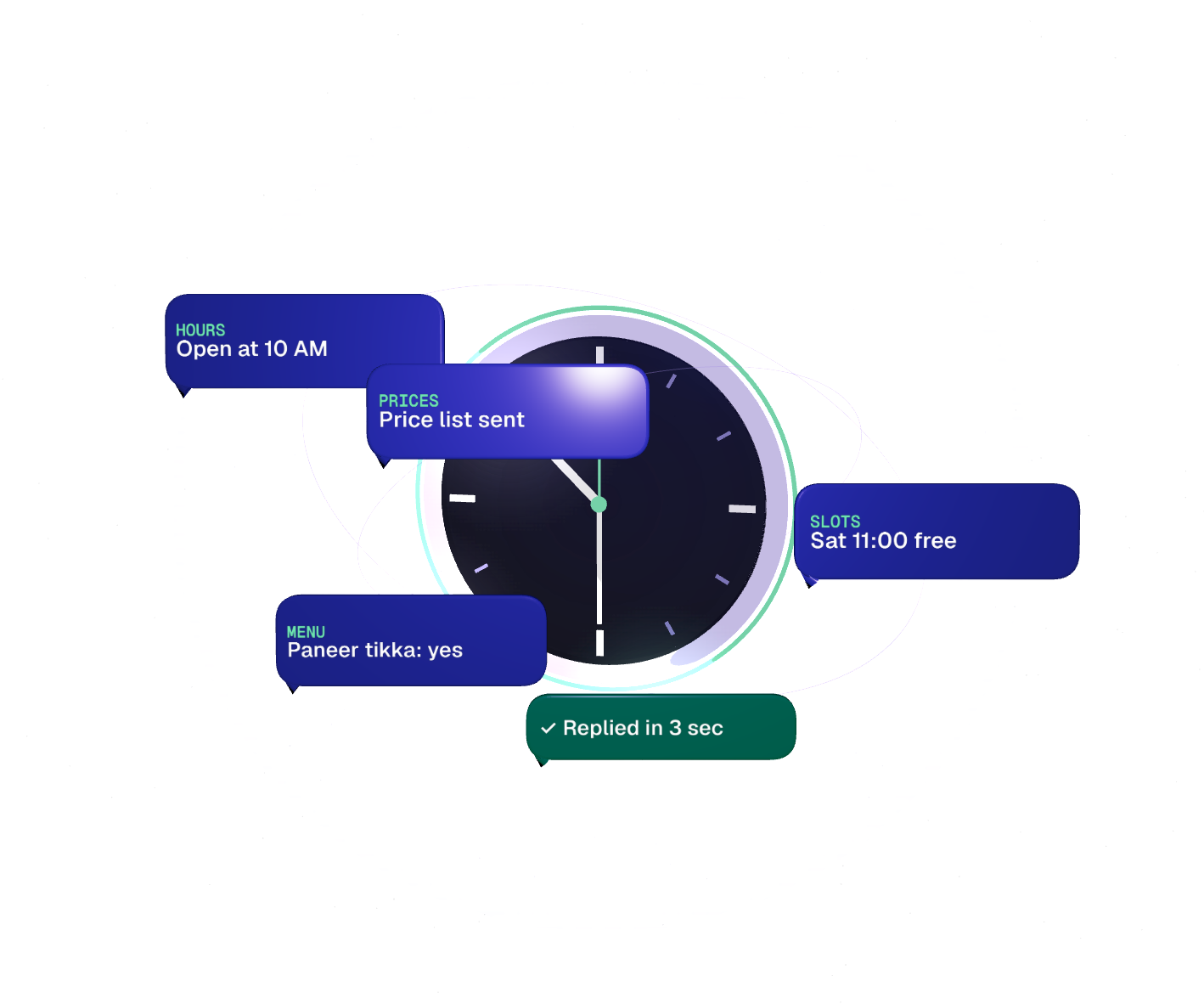
Most late-night questions are simple, and they are the same few questions again and again: how much is this, is it in stock, what is on the menu today, is there a slot on Saturday, what time do you open?
How much is the family thali?
Here is today's price list from our menu. The family thali serves four.
replied in 2 secIs the paneer tikka still available?
Yes! It is on tonight's menu, and it is vegetarian.
replied in 3 secAny appointment on Saturday?
Saturday has 11:00 and 4:30 free. Shall I book one?
replied in 2 secWhat time do you open tomorrow?
We open at 10 AM. Delivery runs until 11 PM.
replied in 1 secAn AI employee answers these in seconds, at any hour, in the same chat the customer already opened. A restaurant's AI can share today's menu and say which dishes are vegetarian. A clinic's AI can check which appointment times are free and offer them. A boutique's AI can confirm a size is in stock and tell the customer when the store opens.
Every quick, clear answer removes a reason to hesitate. A customer who gets what they need in a minute is far more likely to say "Okay, book it" or "I will take two" while the decision is still fresh.
Accuracy matters more than speed. A fast wrong answer is worse than a slow right one. A good AI employee answers only from your business's own knowledge: your price list, your menu, your appointment calendar, your store hours and your policies.1 If the answer is not in what you have given it, it does not guess. It says so honestly and brings in a person.
The handoverWhen a person needs to step in
Some conversations need a human. A bulk order with special requests. A customer who is upset about a late delivery. A health question that only your pharmacist should answer. A good AI employee knows its limits, and the handover is where trust is won or lost.
Here is what a smooth handover looks like:
- The customer is told what happens next. No silence, no loop of the same answer. A clear message such as "I have passed this to our team. Someone will reply first thing in the morning" keeps the customer calm and informed.
- The chat history carries over. When your team member picks it up, they see the full conversation: what was asked, what was already answered, and what the customer needs. The customer never has to repeat themselves.2
- The person is in charge. Once a human takes over, the AI steps back and stays quiet, so the customer is not talking to two voices at once.
Done this way, the customer barely notices the switch. They just feel looked after, at night by your AI employee and in the morning by your team.
For your businessWhat this means for a small business
Think of the questions you answer every single day. The same price, the same timings, the same "do you deliver here?". Each one takes a minute, and together they take hours. An AI employee takes those off your plate, day and night, and leaves you the conversations that really need you.
It also makes your business feel bigger than it is. A two-person shop that replies at midnight feels as reliable as a big chain. And the customer who got a quick, honest answer at 10:30 PM is the one who walks in at 10 AM, already decided.
A few things to keep in mind as you start:
- Feed it well. Keep your prices, menu, hours and policies up to date. The AI is only as good as what you teach it.
- Decide what it should never handle. Complaints, refunds and anything sensitive can go straight to a person.
- Read the chats now and then. You will learn what customers ask most, and what to add next.
- Respect the customer's choice. Answering a question someone asked is service. Sending offers they never asked for is not. Keep consent and an easy opt-out in place.3
Meet your night shift
Hey Tomo gives your business AI employees that answer customers on WhatsApp and Instagram, any time of day, using only what you have taught them. When a question needs you, Tomo tells the customer someone will reply and hands you the whole chat. Let Tomo do it for you, or set it up yourself.
Text of this article
Copy the full text to read later or share with your team.
Notes
- Hey Tomo's AI employees answer only from the knowledge a business adds, such as its price list, menu, calendar, hours and policies. When the answer is not there, they say so and pass the chat to a person. ↩
- The person who takes over sees the full chat, including what the AI employee already answered, in the Hey Tomo inbox. ↩
- Replies to a customer's own question are service messages. Offers and reminders still need consent, keep daytime quiet hours and stop as soon as the customer asks, in any language. ↩